
Impact Award
Grand Challenges: Microbiome Sciences


News
Stephanie Yarwood Named the New Ray R. Weil Endowed E-Nnovate Professor in Soil Science
April 27, 2026
NIH Funds "Smart Pill" for Gut Health Monitoring
March 31, 2026
Mid-Atlantic Microbiome Meet-up Marks 10th Anniversary with Focus on Engineering and Data-Driven Discovery
March 23, 2026
UMD Microbiome Fellows Cap Seven-Month Program with Public Health Panel
February 25, 2026
Tomorrow’s Smart Pills Will Deliver Drugs and Take Biopsies
February 18, 2026
UMD Scientists Create ‘Smart Underwear’ to Measure Human Flatulence
February 11, 2026
Tiny Microbes, Big Impact on Women’s Health
November 6, 2025
UMD Research Group Monitors Urban Agriculture to Keep Antimicrobial Resistance in Check
October 14, 2025
When Physics and Math Go Viral
September 26, 2025
A Pathogen Is Persisting in Infant Formula. UMD Researchers Found Genetic Clues to Explain Why
July 11, 2025
Yarwood Helps Lead UMD Microbiome Sciences Initiative
June 30, 2025
Fellowship Program Builds Bridges in Microbiome Sciences
June 20, 2025
UMD Microbiome Initiative Co-Hosts Mid-Atlantic Microbiome Meetup
March 31, 2025
Unlocking the Secret Carbon Storage in Soil
March 31, 2025
Designing A Drug to Prevent Preterm Birth
March 28, 2025
Building Systems to Support More Powerful Real-Time Health Monitoring
February 11, 2025
Detecting Troubling Gastrointestinal Conditions Earlier With Ingestible Capsules
December 16, 2024
FDA-Funded Study Could Lead to Advances in Fight Against Endometriosis
September 20, 2024
Hall Receives $3.5M in Federal Funding for Innovative Gut Microbiome Research
September 11, 2024
Safeguarding Our Salads From the Roots Up
August 29, 2024
The New Frontier of Microbiome Science: Computational Challenges and Solutions
April 12, 2024
Events
February 10, 2026
MicroSocial Seminar Series, BRB 1103, 3:30–4:30 p.m.
The MicroSocial Seminar Series aims to facilitate scientific exchange and community building across the University of Maryland's microbiome research community. Seminars feature short talks by students and faculty, followed by 30 minutes of informal socializing over coffee and snacks.
Talk Title: “Pollution, the microbiome and asthma: How are they linked?”
Speaker: Norberto Gonzalez-Juarbe, Assistant Professor, Department of Biology, UMD
February 24, 2026
MicroSocial Seminar Series, BRB 1103, 3:30–4:30 p.m.
The MicroSocial Seminar Series aims to facilitate scientific exchange and community building across the University of Maryland's microbiome research community. Seminars feature short talks by students and faculty, followed by 30 minutes of informal socializing over coffee and snacks.
Talk Title: “Engineering bacterial multicellular structures for therapeutic applications”
Speaker: Varunaa Sri Hemanth Kumar, Graduate Student
Talk Title: “Richness, Resources, and Resistance: How environment drives colonization resistance”
Speaker: Ethan Rappaport, Postbac, Department of Biology
March 10, 2026
MicroSocial Seminar Series, BRB 1103, 3:30–4:30 p.m.
The MicroSocial Seminar Series aims to facilitate scientific exchange and community building across the University of Maryland's microbiome research community. Seminars feature short talks by students and faculty, followed by 30 minutes of informal socializing over coffee and snacks. Speaker: Marcus Fedarko, a postdoctoral associate at the University of Maryland Institute for Advanced Computer Studies
Talk Title: "Hierarchical Decomposition and Visualization of Metagenome Assembly Graphs"
March 20, 2026
Annual M3 Microbiome Symposium
The annual meeting of the Mid-Atlantic Microbiome Meet-up (M3) initiative aims to enable and spur interactions within the very broad community of scientists interested in microbiome within the Mid-Atlantic region, including academia, government, and industry participants alike. Visit the Microbiome website for more information.
April 7, 2026
MicroSocial Seminar Series, BRB 1103, 3:30–4:30 p.m.
The MicroSocial Seminar Series aims to facilitate scientific exchange and community building across the University of Maryland's microbiome research community. Seminars feature short talks by students and faculty, followed by 30 minutes of informal socializing over coffee and snacks. Speaker: Julia Segre, NIH Distinguished Investigator, Translational and Functional Genomics Branch, NIH-NHGRI
April 21, 2026
MicroSocial Seminar Series, BRB 1103, 3:30–4:30 p.m.
The MicroSocial Seminar Series aims to facilitate scientific exchange and community building across the University of Maryland's microbiome research community. Seminars feature short talks by students and faculty, followed by 30 minutes of informal socializing over coffee and snacks.
Speaker: Victor Moronge Mochama, graduate student in the Department of Nutrition and Food Science
Talk Title: "Three Clostridium Species with Health-Promoting Properties: In Vitro Screening for Probiotic Potential"
Speaker: Sydney Overton, Graduate student in the Clark School of Engineering
Talk Title: "Ingestible Capsules for Measuring Gastrointestinal Serotonin"
Summary
Complex microbial communities (known as microbiomes) inhabit virtually every part of our planet—from ocean depths to mountaintops, across vegetation surfaces, within agricultural soil, and both on and within all living creatures. The Microbiome Sciences initiative joins faculty, postdoctoral scholars and graduate students from across the University of Maryland in pursuit of a deeper understanding of complex microbial communities, and how those microbiomes interact with each other and with our ecosystem.
The initiative will conduct transformative research, develop new technologies, advance microbiome science, and translate microbiome science into innovative interventions and economic growth. Its three-part mission includes:
- Advancing cutting-edge and transformative interdisciplinary research in microbiome sciences.
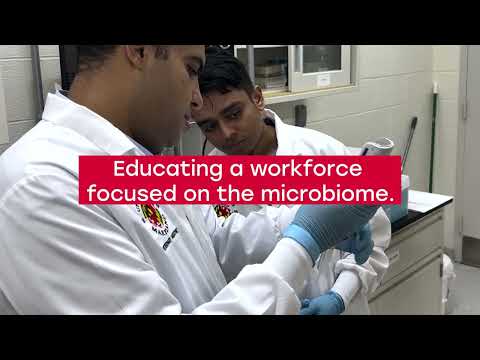
- Training future generations of scientists and helping develop a regional workforce with strong expertise in microbiome sciences.
- Supporting the development of a regional innovation ecosystem that contributes to economic growth in microbiome-related industries within Maryland.


Research
Human Health Advancement
Key participants: Birthe Kjellerup (lead), Ryan Blaustein, Brantley Hall, Katharina Maisel, Shirley Micallef, Margaret Slavin, Magaly Toro, and Hannah Zierden
Researchers in the Center study the impact of microbial communities on human health along a broad set of dimensions. Projects include research on human nutrition, food safety, biomimetic therapies, and wastewater surveillance.
Environmental and Agricultural Innovation
Key participants: Stephanie Yarwood (lead), Ryan Blaustein, Mostafa Ghanem, Birthe Kjellerup, Shirley Micallef and Magaly Toro
Research in this space focuses on the complex interactions, mediated by microbes, between agricultural and environmental systems. Some examples of projects include studies of soil microbial ecology and function, bioremediation of pollutants, the interaction between urban farming and food safety, and the protection of poultry from pathogens.
Technology Development
Key participants: Mihai Pop (lead), Bill Bentley, Brantley Hall, Reza Ghodssi, Huang Lin, Katharina Maisel, Sara Molinari, and Hannah Zierden
A unique feature of our center is the strong focus on the development of new technologies for extracting and analyzing data from microbial communities and for engineering microbial systems. This research includes the development of new sensing modalities, methods for engineering microbiome systems, and novel computational and statistical analysis methods.
Quantitative Microbial Dynamics and Ecosystems
Key participants: Joshua Weitz (lead), Huang Lin, and Mihai Pop
The way in which a microbiome is shaped by the complex interactions between its members, and by the interactions between the microbiome and its environment or host, cannot be effectively understood without the development of complex mathematical models of genome evolution and system dynamics. Some of the research performed in the center, for example, explores the way in which the complex interactions between phages (viruses that infect bacteria) and microbes can be used to treat antibiotic-resistant infections.
 PI: Mihai Pop
Professor and Director, Institute for Advanced Computer Studies
CMNS Mostafa Ghanem
Assistant Professor, Veterinary Medicine
AGNR Birthe Kjellerup
Associate Professor, Civil and Environmental Engineering
ENGR Shirley Micallef
Professor, Plant Science and Center for Food Safety and Security Systems
AGNR Brantley Hall
Assistant Professor, Cell Biology and Molecular Genetics
CMNS William Bentley
Robert E. Fischell Distinguished Professor, Director, Robert E. Fischell Institute for Biomedical Devices, and Director, Maryland Technology Enterprise Institute
ENGR Reza Ghodssi
Professor, Herbert Rabin Distinguished Chair in Engineering
ENGR Katharina Maisel
Assistant Professor, Bioengineering
ENGR Stephanie Yarwood
Associate Professor, Environmental Science and Technology
AGNR Ryan Blaustein
Assistant Professor, Nutrition and Food Science
AGNR Hannah Zierden
Assistant Professor, Chemical and Biomolecular Engineering
ENGR Margaret Slavin
Associate Professor, Nutrition and Food Science
AGNR Diana Obanda
Assistant Professor, Nutrition and Food Science
AGNR Gabi Steinbach
Program Coordinator and Associate Research Scientist
CMNS Sara Molinari
Assistant Professor, Bioengineering
ENGR Huang Lin
Assistant Professor, Biostatistics
SPHL Magaly Toro
Director, Center for Food Safety and Security Systems
JIFSAN Norberto Gonzalez-Juarbe
Assistant Professor of Cell Biology and Molecular Genetics
CMNS Monika Proszkowiec Weglarz
Molecular Biologist, USDA
 Jude Maul
Research Ecologist, USDA
Partnerships:
- Mid-Atlantic Microbiome Meet-up (M3) Consortium