
UMD Announces 2025 Independent Scholarship, Research and Creativity Awards
January 16, 2025
The University of Maryland’s Office of the Provost and Office of the Vice President for Research have announced the ten recipients of this year’s Independent Scholarship, Research, and Creativity Awards (ISRCA). Now in its fifth year, the program provides grant funding to support a diverse range of research and scholarly projects, including studies on climate change, A.I. ethics, and archaeological investigations of Norse sites.
“This pivotal program highlights our faculty’s creativity and expertise across diverse disciplines in many exciting forms and innovative ways,” said Jennifer King Rice, UMD’s Senior Vice President and Provost. “We look forward to seeing the results of these compelling projects brought to fruition.”
Launched in 2019, the ISRCA program aims to advance the professional development of faculty engaged in scholarly and creative work. Eligible projects may utilize historical, humanistic, interpretive, or ethnographic approaches; explore aesthetic, ethical, and/or cultural values and their roles in society; conduct critical or rhetorical analysis; engage in archival and/or field research; and develop or produce creative works. Awardees are selected based on peer review of the quality of the proposed project, the degree to which the project will lead to the applicant’s professional advancement, and the potential academic and societal impact of the project.
The 2025 awardees, representing five colleges and nine departments across campus, will each receive up to $10,000 to support their research endeavors and associated expenses.
“I am happy to see the continued strong interest and engagement in this program from our faculty, as well as the broad spectrum of subjects that the research and scholarship supported by these grants will explore,” said Vice President for Research Gregory F. Ball.
This year’s award recipients are:
Waving: From Space to Ocean
Mollye Bendell, Assistant Professor (ARHU - Art)
Waving: From Space to Ocean is an immersive, interactive artwork that invites viewers to interact with data from NASA’s new PACE (Plankton, Aerosol, Cloud, ocean Ecosystem) satellite through their own physical gestures.
The Rise of the Viceregal Metropolis: Architecture and Urbanism in Enlightenment-Era Mexico City (1750s-1810s)
Juan Burke, Assistant Professor (ARCH-Architecture)
This book project on The Rise of the Viceregal Metropolis: Architecture and Urbanism in Enlightenment-Era Mexico City examines the dramatic transformation of Mexico City between the 1750s and 1810s, a period during which the city became the most populous and dynamic urban center in the Americas.
The Hotel of Babel
Gabrielle Fuentes, Associate Professor (ARHU - English)
This project will result in a linked short story collection entitled “The Hotel of Babel,” which reimagines Cuban history and Cuban-U.S. relations using the fantastical setting of an impossibly large, constantly morphing, and possibly sentient hotel and its many different inhabitants over the centuries, exploring issues of exile, immigration, political oppression, over-tourism, and climate crisis.
Ballistic Middens - Investigating the Norse Middens of South Uist, Outer Hebrides, Scotland
George Hambrecht, Associate Professor (BSOS - Anthropology)
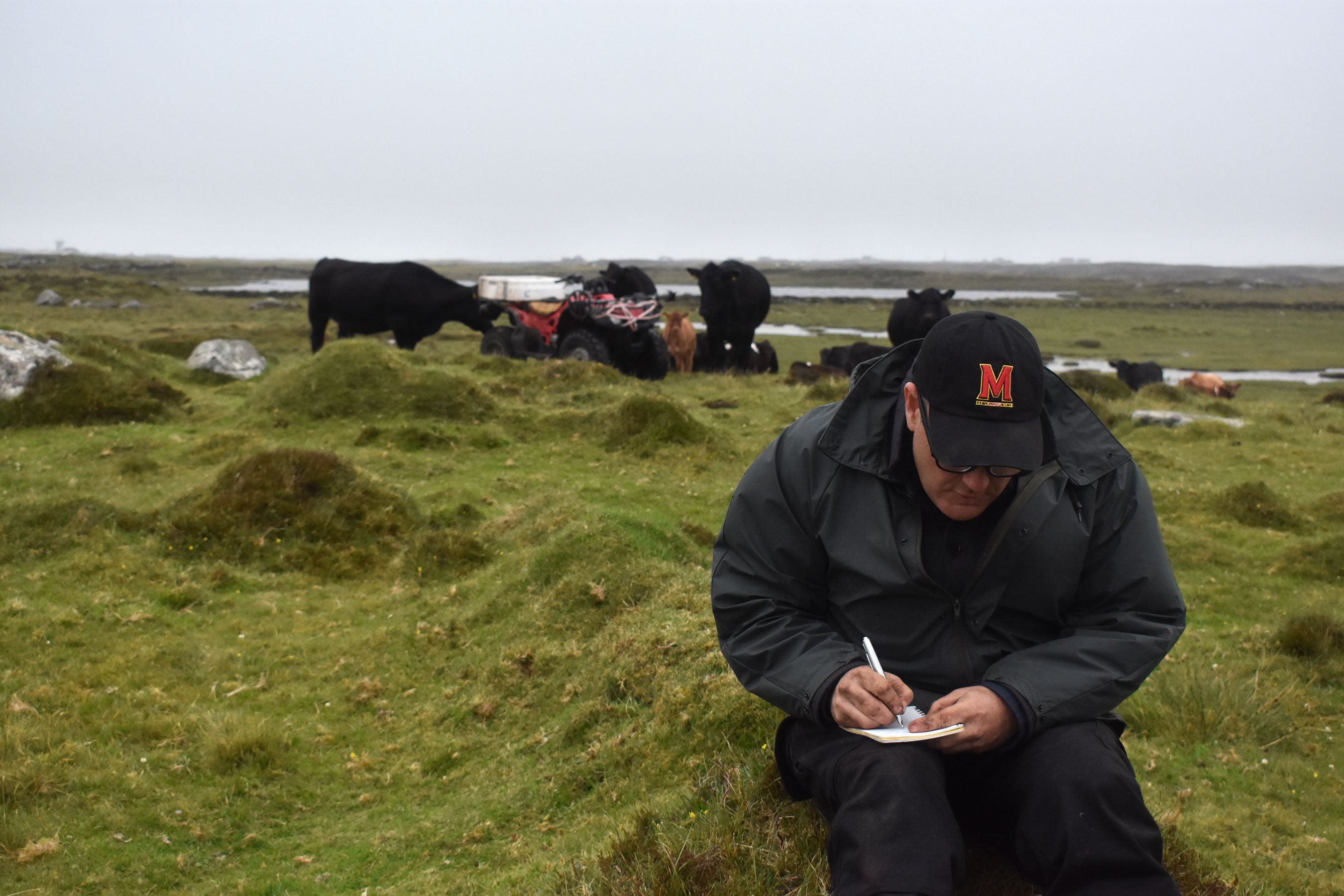
This project will focus on an archaeological sampling of middens on South Uist, Outer Hebrides, Scotland, filling a crucial gap in our understanding of Norse expansion and long-term human-environment interactions in the North Atlantic region and expanding our understanding of long-term human-marine interactions in the region.
Racialized Democracy: The Electoral Politics of Race in Latin America
Marcus Johnson, Assistant Professor (BSOS - Government and Politics)
This project will result in the completion of a book manuscript titled, Racialized Democracy: The Electoral Politics of Race in Latin America, which examines race and Latin American political behavior.
The Canary in the Vineyard: Climate Change and Biodiversity Loss in Italian Viniculture
Kathryn Lafrenz Samuels, Associate Professor (BSOS - Anthropology)
Viniculture offers a “canary in the coal mine” case for witnessing the coming impacts of climate change and biodiversity loss to agricultural production, given the particular sensitivity of wine grapes to temperature fluctuations. This project studies wine grape cultivation in three areas of Italy, exploring the social value placed on biodiversity, and what is lost with biodiversity loss.
Machines as Moral Experts? AI-powered Ethical Reasoning in Biomedical Research Oversight
Nicholas Laskowski, Assistant Professor (ARHU - Philosophy)
Machines as Moral Experts? will draw on expertise in AI safety and governance, bioethics, and theoretical and applied ethics to help document the gap between machine ethics and human ethics, the risks of outsourcing ethical reasoning in high-stakes use-cases, and the possible benefits of some AI- powered decision support tools to reduce harmful burdens on ethics professionals and biomedical researchers.
#RiotsNotDiets: Fat-Positive Worldmaking in the Body Positivity Movement
Hailey Otis, Assistant Professor (ARHU - Communication)
This project will result in the completion of a new book, #RiotsNotDiets: Fat-Positive Worldmaking in the Body Positivity Movement, which weaves together rhetorical analysis, critical autoethnography, and oral histories to uplift the voices of body positive activists and influencers and examine the future viability of this social movement.
EMPOWER: Disseminating the findings of the Empower study on transphobia-driven intimate partner violence through art to empower marginalized transgender communities
Sarah Peitzmeier, Assistant Professor (SPHL - Behavioral and Community Health)
This project will result in a graphic novel that will share research findings and improve understanding of the increased risks of intimate partner violence for trans and nonbinary people and support trans survivors.
Is Cognitive Development Universal? Critical Approaches to Cognition
Richard Prather, Associate Professor (EDUC - Human Development and Quantitative Methodology)
The objective of this project is to produce a set of resources for researchers and students who are interested in critical approaches to human cognition, including an integrative review paper and the creation of an “online knowledge base” that will make resources available for learning new research methods relevant to critical approaches.
Silvana Montañola
Graduate Assistant