Skip site navigation
University of Maryland Division of Research
Who We Are Capabilities Partnerships Resources News
Analytical Nuclear Magnetic Resonance (NMR) Service & Research Center Biomolecular Nuclear Magnetic Resonance (NMR) Facility Biosciences Cores: Genomics, Imaging, and Flow Cytometry BioWorkshop Brain & Behavior Institute - Advanced Genomic Technologies Core CALCE Test Services and Failure Analysis Laboratory Center For Innovative Biomedical Resources (CIBR) Clarice Smith Performing Arts Center Daikin Energy Innovation Lab DLAR Imaging Core Exposome Small Molecule Core Facility Glenn L. Martin Wind Tunnel Herschel S. Horowitz Center for Health Literacy KIT-Maryland MEG Lab Maryland Fire and Rescue Institute (MFRI) Maryland NanoCenter Maryland Neuroimaging Center Mass Spectrometry Facility Michelle Smith Collaboratory for Visual Culture Neutral Buoyancy Research Facility (NBRF) Surface Analysis Center The Laboratory for Biological Ultrastructure The University of Maryland Center for Health Equity The University of Maryland Prevention Research Center X-ray Crystallographic Center (XCC)
Africa Through Language and Area Studies (ATLAS) Anti-Black Racism Initiative Effective and Equitable Weather Forecasting in a Changing Climate with Machine Learning Encuentros: A University-Community Partnership to Mitigate the Mental Health Crisis for Latino Immigrant Youth Fostering Inclusivity through Technology (FIT) Helping Our Bodies Clear Respiratory Infections The Maryland Safe Drinking WATER Study Modeling the Evolution of Avian Influenza Viruses Music Education for All Through Personalized AI and Digital Humanities Observing Wildfires Through UAVs and Fire Imaging Technologies Programmable Design of Sustainable, All-Natural Plastic Substitutes Racial and Social Justice Research-Practice Partnership Collaborative Remediation of Methane, Water, and Heat Waste Seizing Opportunities: Social Capital, Businesses, and Communities Using Machine Learning to Measure and Improve Equity in K-12 Mathematics Classrooms Water Emergency Team
Accurate, Equitable, and Transparent Genetic Ancestry Inference Advancing Environmental Justice By Evaluating Climate-Ready Urban Street Trees In Historically Redlined Neighborhoods AFTER: A Hospital Violence Intervention Program For Youth Victims of Gunshot Injury An Innovative Intervention to Help Asian American Families Cope with Racism and Mental Health Difficulties Bridging the Gaps in Satellite Observations of Earth Systems to Support Climate Monitoring and Prediction Climate Change and Political Conflict Climate Mitigation and Land-Use Digital Equity Mapping Research and Training Program Establishing a Role for Psilocybin in Frontal Lobe Function Fetal Mammary Stem Cell Programming and Hormone Dysfunction Forecasting Acute Malnutrition for Anticipatory Action Genetic and Lifestyle Risk Factors of Accelerated Brain Aging in Severe Mental Illness How Does Statistical Learning Interact with Socioeconomic Status to Shape Literacy Development? Human Rights Politics and Policies: Lessons from Latin America Increasing Sustainability, Accessibility, and Equity in Urban Mobility with A Self-driving E-Scooter Increasing Participation of Minorities and Women In STEM Through Sports Performance Analytics Research Market Design, Energy Storage, and Interconnection to the U.S. Power Grid On-board Energy Harvesting for Long-endurance Earth Observation UAVs Promoting Youth Mental Wellbeing in Rural Honduras by Engaging Teachers as Catalysts Relating Attitudes on Democracy to Attitudes on Race and Ethnicity An Innovative Approach to Remove Emerging Organic Contaminants from the Environment Role of Mitochondria Dynamics in Opioid Addiction Towards an Early Warning System for Increased Probability of Community Infection by SARS-Cov-2 Variants Understanding the Impact of Wind on Fire Dynamics in Mass-Timber Compartment Visualizing Urban Flooding Due To Climate Change
Search
Who We Are Capabilities Partnerships Resources News

Olympus Discovery Center Inaugurated at UMD

On Friday, Feb. 25, Olympus joined the University of Maryland (UMD) in celebrating the grand opening of its new Olympus Discovery Center.

March 04, 2022

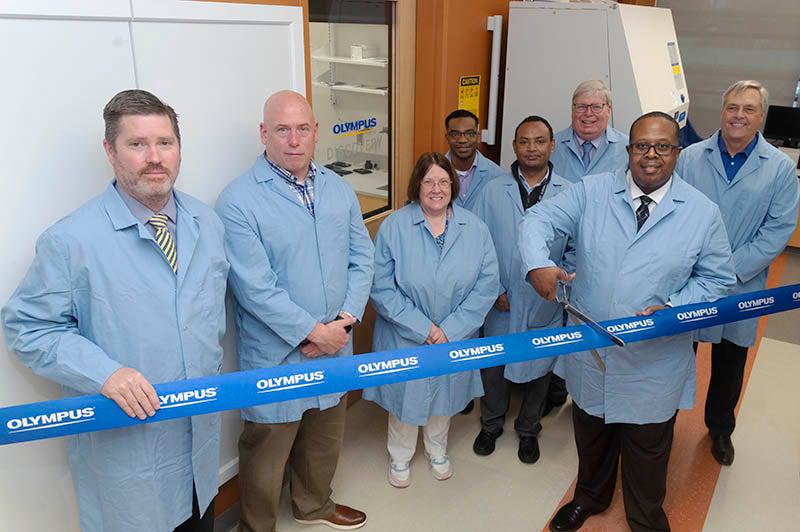
Ribbon cutting on Olympus Discovery Center
On Friday, Feb. 25, Olympus joined the University of Maryland (UMD) in celebrating the grand opening of its new Olympus Discovery Center. 

Instrumental Tools for Bioscience and Biotech Innovators
The inauguration of the Olympus Discovery Center at UMD equips its bioengineering researchers with crucial imaging tools to expand and progress their research. Providing a suite of powerful, high-performance microscopy systems, the new facility enables observation deep into living tissue to encourage ground-breaking study of cellular and subcellular events.

Housed in A. James Clark Hall, the new Olympus Discovery Center is located in a hub of engineering innovation and cross-disciplinary collaboration. Under the same roof, students exploring novel approaches and strategies in a range of bioscience and biotechnology research areas can share and benefit from the center’s imaging resources.

Supporting Breakthroughs in Bioengineering Research
To enable the observation of cell cultures and living tissues down to the subcellular level, equipment at this Olympus Discovery Center includes a FLUOVIEW™ FV3000RS laser scanning confocal system, a FVMPE-RS™ multiphoton system, an IX83 IXplore™ live cell system, as well as a CKX53 cell culture microscope and SZ/SZX series stereo microscopes.

“The cutting-edge equipment made available through the Olympus Discovery Center at the University of Maryland will provide our world-class researchers with additional tools to advance knowledge in critical areas such as cancer diagnosis and treatment, cell biology and tissue engineering,” says Gregory Ball, Vice President for Research at the University of Maryland. “I look forward to the future discoveries this partnership will help unlock.”

“Inaugurating an Olympus Discovery Center at UMD fits with our continued efforts to provide bioscience innovators the resources they need to further their scientific aims,” says Lee Wagstaff, Vice President of Sales and Marketing for Olympus Scientific Solutions Americas. “We are proud that Olympus microscopy technologies will assist UMD scientists in making discoveries that will shape the way we treat injuries and diseases.”

Olympus Discovery Centers provide researchers the ability to acquire and analyze vital imaging data using advanced microscopy tools. They also serve as a nexus for histology training, information and technique development, as well as a center for learning sample preparation, imaging and image processing. Olympus works closely with its academic partners to develop new products to meet the changing needs of researchers.

About Olympus
Olympus is passionate about creating customer-driven solutions for the medical, life sciences, and industrial equipment industries. For more than 100 years, Olympus has focused on making people’s lives healthier, safer and more fulfilling by helping to detect, prevent, and treat disease; furthering scientific research; and ensuring public safety.

Olympus has manufactured microscopes since the company’s founding in 1919. Today, our Life Sciences business is dedicated to meeting and exceeding the evolving needs and expectations of life science professionals through a comprehensive range of clinical research, educational, and high-end research microscopes and microscope systems. For more information, visit www.olympus-lifescience.com.

###

Photo details (pictured from left to right): Fischell Department of Bioengineering Chair John P. Fisher, Olympus Corporation of the Americas Executive Director of Marketing for Life Science David RideoutDepartment of Laboratory Animal Research (DLAR) Facility Veterinarian and Imaging Core Director Beth Bauer, DLAR Attending Veterinarian Larry Shelton, DLAR Imaging Core Technical Coordinator Betre Legesse, UMD Vice President for Research Gregory BallA. James Clark School of Engineering Dean Samuel Graham, Jr., and Olympus Scientific Solutions Group National Sales Director Jeff Bright.