
Animal Research CUE Sheet - 09.16.2025
September 16, 2025

Animal Care and Use Express (CUE) Sheet
A bi-monthly (ish) communication from the UMD Animal Care Program with important information to keep you right on cue!
AY 25-26 | Issue 3
September 16, 2025
Semi-Annual IACUC Inspections Coming
Fall semester semi-annual inspections begin in a few weeks (October 1)! Many of you are familiar with the process, but it is helpful to refresh your memory using information on our “Inspections” webpage. Open the accordion menus below for a brief overview, and a quick guide based on the Spring 2025 Inspections.
Inspection FAQs
Why do we perform inspections?
Federal regulations require us to inspect our facilities and review our program at least once every six months. In addition to meeting our regulatory requirements, inspections allow us to ensure the highest quality safety and health of the animals and personnel engaged in animal research activities.
These also provide us with an opportunity to identify programmatic and ongoing deficiencies before they become reportable non-compliance issues.
What spaces get inspected?
ALL areas in which live animals are housed, undergo procedures (such as surgery) or are euthanized and also…
ALL areas that are utilized for animal research support including storage areas, cage wash areas, corridors within dedicated large vivaria, imaging facilities, and more.
These areas include centralized and satellite facilities where animal care is provided by dedicated staff, as well as Principal Investigator, or PI-managed facilities where animal care is completely provided by the PI and/or other trained lab members.
Who performs the inspections?
Generally speaking, at least two members of the IACUC must be present at the inspection of each space, and all members of the IACUC are invited to participate in the inspection of any space.
For larger spaces, like the farms or our larger vivaria, the IACUC may use larger groups or sub-groups of inspectors who will look at different parts of the facility.
How can I prepare for an inspection?
Broadly, inspectors look for findings pertaining to information found in regulatory documents like the Animal Welfare Act and the PHS Policy, as well as publications like the Guide, the Ag Guide, and others. We also have institutional standards and guidelines.
UMD researchers and facilities personnel are expected to operate in compliance with these standards in an ongoing basis, so no special preparation should be required. We provide our Inspection Checklist (DOCX) publicly on our website and in IRBnet for all inspectors and researchers to refer to at any time, but it is especially important to familiarize yourself with the checklist before each inspection round.
Inspections FAQs PDF available upon request. Click here to email the IACUC Office.
Spring 2025 Findings and Quick Guide
We have been able to digest data from the Spring ‘25 semi-annual inspection to provide some guidance on things to look out for:
- COMMON FINDING CATEGORIES | These are findings that we encounter in many different types of animal facilities, but each space is unique!
- Training and Documentation | These findings pertain to required lab personnel training and in-date documentation of such. Commonly, Section 2 items on the Checklist.
- Safety/Cleaning | These findings pertain to avoidable occupational, first aid and biosafety issues for humans and animals. Commonly, Section 3 items on the Checklist.
- Physical Plant | These findings pertain to issues with the physical space in which animal activities take place. Commonly, items 3.a.i-iv on the Checklist.
- Storage/Disposal | These findings pertain to issues with the storage of items used in animal activities, and the systems for managing the storage of those items to include temperature and humidity, expiration dates, and more. Commonly, Section 4 items on the Checklist.
- WHERE ANIMALS ARE HOUSED/PRESENT | These are findings that we look for when animals are continuously housed in a space or if they happen to be in the space during the inspection visit.
- Animal Care/Docs | These findings pertain to issues regarding the care and welfare of animals, including health checks, identification, environmental considerations, transportation and more. Commonly, Section 5 items on the Checklist.
- OTHER SPECIAL USE AND SUPPORT AREAS | These findings pertain to areas where animals may or may not be brought to, but are imperative for quality animal care.
- Procedures/Labs | These findings apply to surgical suites and spaces which require special documentation and sanitation. Commonly, Section 8 items on the Checklist.
- Other | These findings pertain to signage requirements, cage wash and autoclaves as they relate to proper use. Commonly, Sections 1, 7 and 9, respectively.
| Spring 2025 Total Findings | Fall 2024 Total Findings | Spring 2024 Total Findings |
|---|---|---|
| 186 | 187 | 220 |

Solutions to Common Findings
To help you get prepared for the Fall 2025 IACUC Inspections, and to help us overcome some of our common findings, use the information below. Some of the solutions are in development, but we are happy to help answer any questions you may have PRIOR to your inspection.
Animal Care and Husbandry
How you can help us:
- Opened feed/bedding/enrichment and cage supplies should be stored in sealable, sanitizable containers and labeled with expiration dates and sanitation dates.
- Be aware of proper sanitation schedules and ensure that food is stored at proper temperatures and documented.
- Animal health must be checked daily, and records must be updated and available. Sick and deceased animals must be reported to the AV.
How we can help you: Our vet staff and post-approval monitor are making a concerted effort to work more closely with researchers and will be reaching out to schedule visits where these types of findings can be prevented with reminders.
- In an emergency, the on-call veterinarian will be able to assist you. Call 301.458.5047.
- Health reports for sick or deceased animals should be submitted to dlar@umd.edu AND vets@umd.edu.
- For PI-Managed Housing Areas and Farms, you can use this Google Form to route to the appropriate animal health report.
Training Documentation
How you can help us: ALL training records for ALL lab personnel listed on your protocol should still be maintained in your lab, including PI-Animal User Training, Occ Health Enrollment and other lab-specific training. Please see our updated Standard on Animal Care and Use Training Requirements.
How we can help you: The IACUC Office has created a master registry for all current lab members with their PI-Animal User Training history and Occ Health expiration. We have already reached out to ALL PIs to alert them of their lab's training status. We have also determined that animal care staff and managers in centrally-managed facilities may be exempt from Refresher training every three years in lieu of other continuing education/professional development offered through DLAR. See more information in the Standards section below.
General Cleanliness
How you can help us: Ensure your spaces are free of clutter, dust and debris, and that cleaning implements are not stored directly on the floor. If you encounter rust or other facilities related issues (holes in surfaces, doors not working, etc.), please submit a work request at https://facilitiesservice.umd.edu/.
How we can help you: In determining whether there is an actual finding related to general cleanliness, we will be assess more thoroughly if the debris/dust presents a safety concern for humans or animals (blocking egress or safety equipment, rust, etc.).
Eyewash Maintenance
How you can help us: Identify what kind of eyewash system you have. Is it a plumbed, permanent fixture? Make sure your flushing is complete and the record is filled out EVERY WEEK on the same date of the week. Is it portable or refillable? Please check care/maintenance instructions and expiration dates PRIOR to inspection to make sure the flush solution is not expired.
How we can help you: Refer to DLAR SOP Series 2200 for general lab safety guidance (2206 offers some guidelines on eyewash usage and maintenance).
Dates/Labeling
How you can help us: Check expiration dates of ALL cleaning supplies, chemicals, drugs and other medical supplies and provide appropriate labels of date opened/mixed as applicable. If using expired materials for non-survival surgeries, label appropriately (e.g., "not for use in survival surgeries"). When in doubt, throw it out!
How we can help you: Detailed guidance is coming in the form of fact sheets, Standards, SOPs, etc. For the moment, see our guidance below for keeping your inventory in check.
- Labels should always include name of contents (and ratio of mixture as applies), date opened or mixed, and expiration date (you may need to check with the manufacturer). It is your responsibility to know the shelf-life of your supplies and to document as needed.
- If dates are not visible, re-label if you know the correct date, or dispose appropriately.
- Create an inventory tracking sheet and keep your supplies organized. Clearly label shelving/cabinetry to avoid confusion. Separate plastic bins to gather like supplies can also help.
Pest Control
How you can help us:
- Pest traps are REQUIRED in animal housing and feed/bedding storage areas and must be checked DAILY.
- In all other areas, pest traps are recommended and where present must be checked daily.
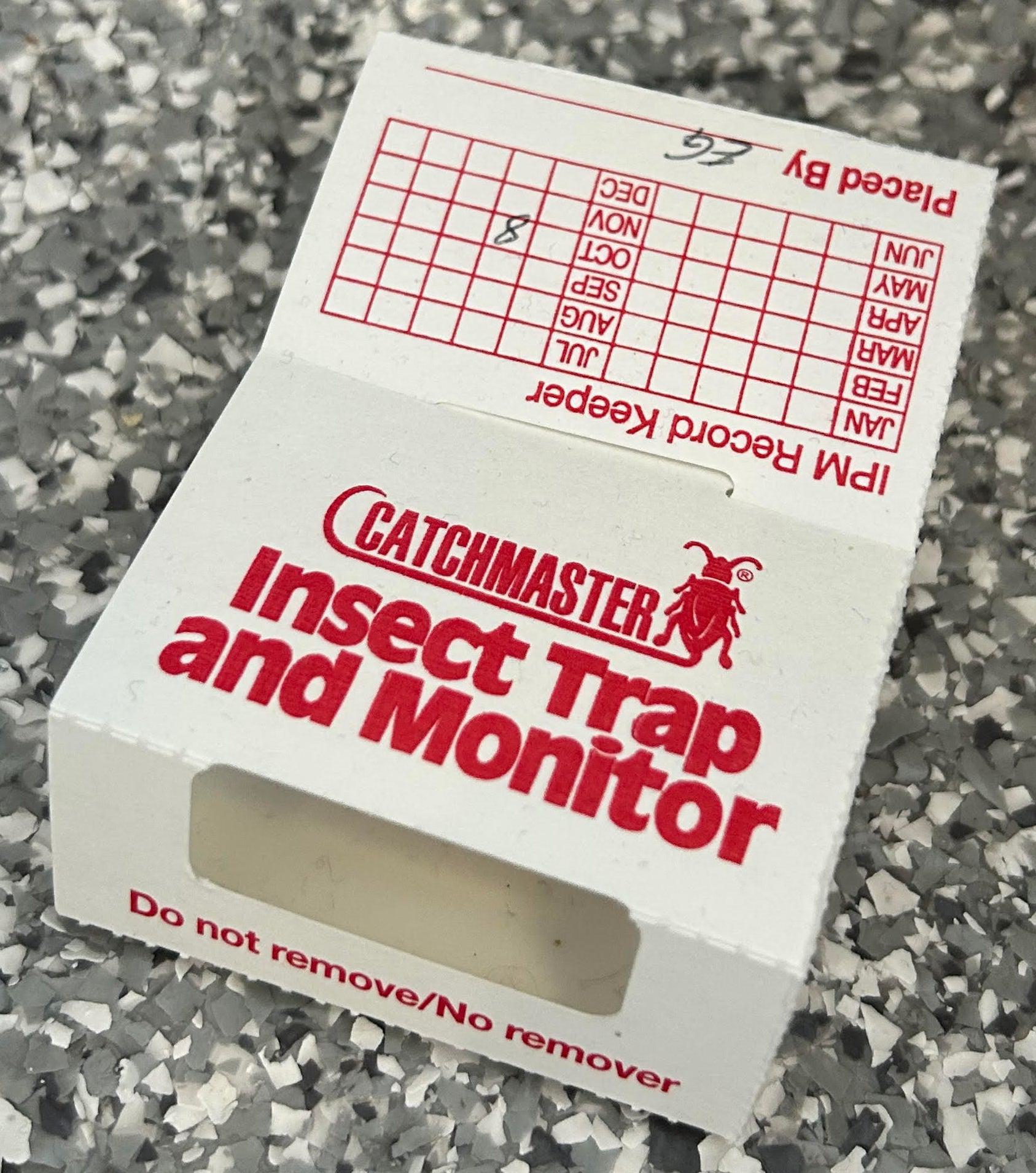
- Pest traps should be small, low-level adhesive traps designed specifically for insects.
- Check traps before inspection: If they have significant activity, call Work Control and replace pest traps.
How we can help you: The image below is what DLAR uses in the centrally-managed vivaria (Catchmaster 288i Insect/Spider Trap & Monitor). Pest monitoring supplies are available from the Pest Management group at FM and can be obtained by submitting a work order or calling 5-2222. They may also be purchased from a variety of vendors. A new Standard on pest control is in the works. If you notice an infestation prior to inspections, please contact Travis Kramer (tkramer@umd.edu). For spaces with bird feed and aquatics areas with floor drains, we recommend making sure that these are clean/flushed--if you think there is a pest concern in your space associated with your drains, please contact FM and place a work order.
Other Reminders
- DLAR and the UAV would like to remind you to use Animal Health Alert cards to notify animal care staff of non-emergency health concerns and to submit all animal health logs to dlar@umd.edu and vets@umd.edu.
- PI-Managed Housing Areas should use their custom tinyurl links and/or QR codes to log animal census numbers in the digital repository each month. The daily numbers should continue to be kept on their paper, in-lab husbandry and health check documents.
- Any questions about ASP submissions, amendments, approvals, grants congruency, and meeting schedules should be directed to iacuc@umd.edu. These emails go to the IACUC Administrative Office Team and are more likely to be responded to efficiently.
Important Dates
2026 IACUC Meeting Dates
Due to the variable nature and volume of protocols reviewed in any given month, we cannot provide exact timelines for approval. We recommend submitting your protocol 3 months prior to whenever you intend to start your work with animals.
Meeting Dates | PIs Submit Protocol By | PIs Submit Pre-Review Modifications By |
September 17, 2026 | August 15, 2026 | September 9, 2026 |
October 15, 2026 | September 15, 2026 | October 7, 2026 |
November 19, 2026 | October 15, 2026 | November 11, 2026 |
December 17, 2026 | November 15, 2026 | December 9, 2026 |
*NO AUGUST MEETING | The IACUC will try to send projects submitted during this time to DMR. Those called for FCR will go to the September meeting.
2027 IACUC Meeting Dates
Due to the variable nature and volume of protocols reviewed in any given month, we cannot provide exact timelines for approval. We recommend submitting your protocol 3 months prior to whenever you intend to start your work with animals.
Meeting Dates | PIs Submit Protocol By | PIs Submit Pre-Review Modifications By |
January 28, 2027 | December 15, 2026 | January 20, 2027 |
February 25, 2027 | January 15, 2027 | February 17, 2027 |
March 25, 2027 | February 15, 2027 | March 12, 2027 |
April 22, 2027 | March 15, 2027 | April 14, 2027 |
May 27, 2027 | April 15, 2027 | May 19, 2027 |
June 24, 2027 | May 15, 2027 | June 16, 2027 |
July 22, 2027 | June 15, 2027 | July 14, 2027 |
NO AUGUST MEETING!* | ||
*NO AUGUST MEETING | The IACUC will try to send projects submitted during this time to DMR. Those called for FCR will go to the September meeting.
Fall 2026 PI/Animal User Training Dates
| NEW PI/Animal User Training | NON-PI Refresher Training | PI-SPECIFIC Refresher Training |
|---|---|---|
New PI/Animal User Training is required for all new PIs, students, assistants, etc., who will work directly with animals. This includes all handling, husbandry, procedures, transportation, etc. | NON-PI Refresher Animal User Training is required every 3 years in order to continue working with animals. | PI-SPECIFIC Refresher Animal User Training is required for all PIs with approved UMD IACUC protocols every 3 years in order to continue working with animals. |
| September 15, 2026 at 11:30 am | September 25, 2026 at 10 am | September 23, 2026 at 10:30 am |
| September 24, 2026 at 10 am | October 5, 2026 at 10:30 am | October 6, 2026 at 1:30 pm |
| October 2, 2026 at 12 pm | October 20, 2026 at 9 am | October 22, 2026 at 8 am |
| October 6, 2026 at 3 pm | November 6, 2026 at 1:30 pm | November 6, 2026 at 9 am |
| October 14, 2026 at 12:30 pm | November 17, 2026 at 11 am | November 16, 2026 at 11 am |
| October 22, 2026 at 10 am | December 2, 2026 at 2:30 pm | December 1, 2026 at 4 pm |
| October 30, 2026 at 12 pm | December 17, 2026 at 2 pm | December 14, 2206 at 3 pm |
| November 10, 2026 at 11 am | ||
| November 19, 2026 at 2 pm |