
Skip site navigation
University of Maryland Division of Research
Who We Are Capabilities Partnerships Resources News
Analytical Nuclear Magnetic Resonance (NMR) Service & Research Center Biomolecular Nuclear Magnetic Resonance (NMR) Facility Biosciences Cores: Genomics, Imaging, and Flow Cytometry BioWorkshop Brain & Behavior Institute - Advanced Genomic Technologies Core CALCE Test Services and Failure Analysis Laboratory Center For Innovative Biomedical Resources (CIBR) Clarice Smith Performing Arts Center Daikin Energy Innovation Lab DLAR Imaging Core Exposome Small Molecule Core Facility Glenn L. Martin Wind Tunnel Herschel S. Horowitz Center for Health Literacy KIT-Maryland MEG Lab Maryland Fire and Rescue Institute (MFRI) Maryland NanoCenter Maryland Neuroimaging Center Mass Spectrometry Facility Michelle Smith Collaboratory for Visual Culture Neutral Buoyancy Research Facility (NBRF) Surface Analysis Center The Laboratory for Biological Ultrastructure The University of Maryland Center for Health Equity The University of Maryland Prevention Research Center X-ray Crystallographic Center (XCC)
Africa Through Language and Area Studies (ATLAS) Anti-Black Racism Initiative Effective and Equitable Weather Forecasting in a Changing Climate with Machine Learning Encuentros: A University-Community Partnership to Mitigate the Mental Health Crisis for Latino Immigrant Youth Fostering Inclusivity through Technology (FIT) Helping Our Bodies Clear Respiratory Infections The Maryland Safe Drinking WATER Study Modeling the Evolution of Avian Influenza Viruses Music Education for All Through Personalized AI and Digital Humanities Observing Wildfires Through UAVs and Fire Imaging Technologies Programmable Design of Sustainable, All-Natural Plastic Substitutes Racial and Social Justice Research-Practice Partnership Collaborative Remediation of Methane, Water, and Heat Waste Seizing Opportunities: Social Capital, Businesses, and Communities Using Machine Learning to Measure and Improve Equity in K-12 Mathematics Classrooms Water Emergency Team
Accurate, Equitable, and Transparent Genetic Ancestry Inference Advancing Environmental Justice By Evaluating Climate-Ready Urban Street Trees In Historically Redlined Neighborhoods AFTER: A Hospital Violence Intervention Program For Youth Victims of Gunshot Injury An Innovative Intervention to Help Asian American Families Cope with Racism and Mental Health Difficulties Bridging the Gaps in Satellite Observations of Earth Systems to Support Climate Monitoring and Prediction Climate Change and Political Conflict Climate Mitigation and Land-Use Digital Equity Mapping Research and Training Program Establishing a Role for Psilocybin in Frontal Lobe Function Fetal Mammary Stem Cell Programming and Hormone Dysfunction Forecasting Acute Malnutrition for Anticipatory Action Genetic and Lifestyle Risk Factors of Accelerated Brain Aging in Severe Mental Illness How Does Statistical Learning Interact with Socioeconomic Status to Shape Literacy Development? Human Rights Politics and Policies: Lessons from Latin America Increasing Sustainability, Accessibility, and Equity in Urban Mobility with A Self-driving E-Scooter Increasing Participation of Minorities and Women In STEM Through Sports Performance Analytics Research Market Design, Energy Storage, and Interconnection to the U.S. Power Grid On-board Energy Harvesting for Long-endurance Earth Observation UAVs Promoting Youth Mental Wellbeing in Rural Honduras by Engaging Teachers as Catalysts Relating Attitudes on Democracy to Attitudes on Race and Ethnicity An Innovative Approach to Remove Emerging Organic Contaminants from the Environment Role of Mitochondria Dynamics in Opioid Addiction Towards an Early Warning System for Increased Probability of Community Infection by SARS-Cov-2 Variants Understanding the Impact of Wind on Fire Dynamics in Mass-Timber Compartment Visualizing Urban Flooding Due To Climate Change
Search
Who We Are Capabilities Partnerships Resources News

Grand Challenges Team Engineers a Designer Protease to Help Clear Respiratory Infections and Disease

September 30, 2024

A collaboration between faculty researchers in the College of Computer, Mathematical, and Natural Sciences (CMNS), the A. James Clark School of Engineering (ENGR), and the First-Year Innovation and Research Experience (FIRE) program supported by the University of Maryland Grand Challenges Grants program is focused on devising innovative solutions for helping our bodies clear respiratory infections. 

Mucus plays an important role as part of our barrier immune response. Depending on the molecular make-up of the mucus, it can either protect us from respiratory bacteria and viruses, or result in thicker mucus that is difficult for our lungs to clear. This build-up of mucus is seen in numerous diseases (e.g., cystic fibrosis, COPD, COVID-19) and can lead to chronic infections. 

Mucus is made up of different mucin proteins, inorganic salts and water. Mucins are large heavily glycosylated proteins that result in a gel-like network that can serve as a net and barrier to protect our cells from microbes. However, the molecular nature of mucus can shift over the course of a respiratory infection and in chronic respiratory diseases. Of the secreted mucins in the hydrogel layer, increases in MUC5AC (relative to MUC5B) result in thicker, more viscous mucus which is associated with poorer outcomes in respiratory diseases. 

Because MUC5AC is overexpressed in disease conditions, the team's goal is to engineer a protease that can recognize and specifically cleave MUC5AC, but leave the other mucins untouched. The research team includes Associate Professor of Cell Biology and Molecular Genetics Louisa Wu (CMNS), Associate Professor of Bioengineering Gregg Duncan (ENGR), Associate Clinical Professor in the FIRE Program Catherine Spirito, Professor Emeritus of the Institute for Bioscience and Biotechnology Research Philip Bryan, and Clinical Assistant Professor in the FIRE Program Quira Zeidan. 

The first pass protease (pT2326) is designed to cleave the sequence DTFQNL-RD (122-131) found in MUC5AC and not MUC5B. This protease does not yet incorporate an aptamer localization element or additional regulatory components,
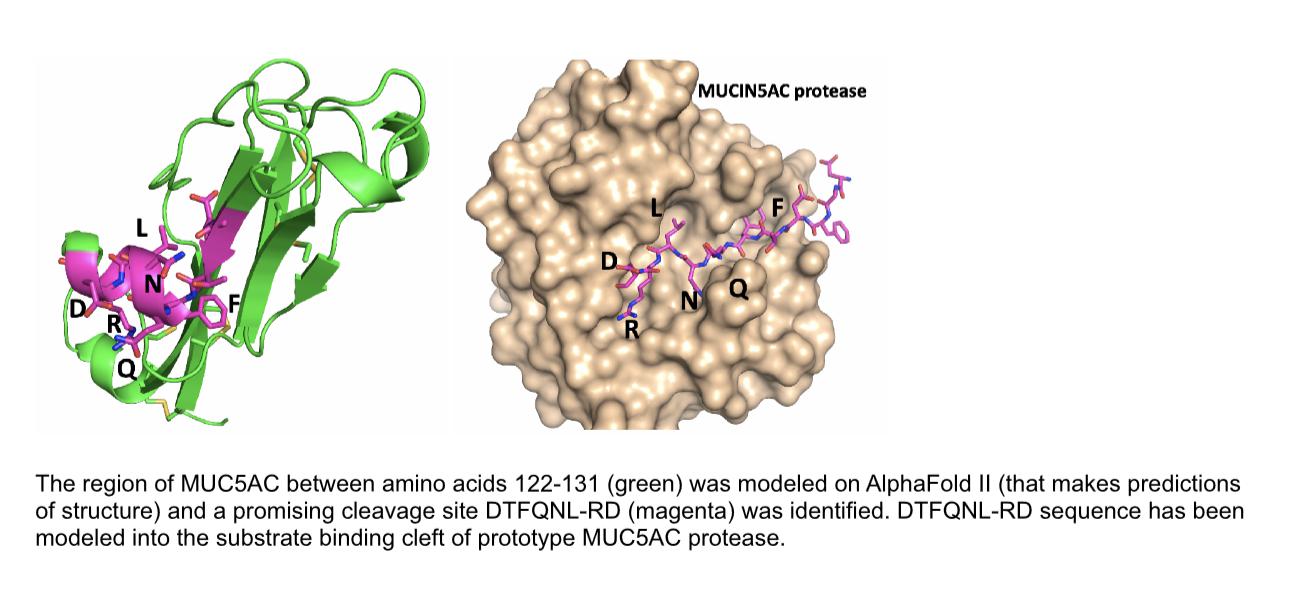
Grand Challenges Research Team Graphic - Grand Challenges Team Engineers a Designer Protease to Help Clear Respiratory Infections and Disease
which will be added later to enhance specificity and efficacy. The protease has been tested for its effect on the viscosity of a mucin gel harvested from airway epithelial cells. Of note, the protease results in a significant increase of movement of a fluorescent particle in the mucus gel layer, indicating that the viscosity of the gel has decreased. A greater proportion of MUC5AC in a mucus gel layer is known to contribute more to viscosity, hence this result suggests that the protease may be acting on its desired target. Cell biology and biochemical experiments to test this are currently in progress. 

The use of a designer MUC5AC protease to specifically localize and cleave the mucin protein that builds up under pathological conditions, but leaves the mucins associated with healthy conditions alone, would be the first of its kind. A therapeutic with this sort of molecular precision is ideal in that it could successfully break down the more viscous mucus seen with disease, but leave healthy mucus alone.

To learn more about this project, visit: https://research.umd.edu/respiratory.