
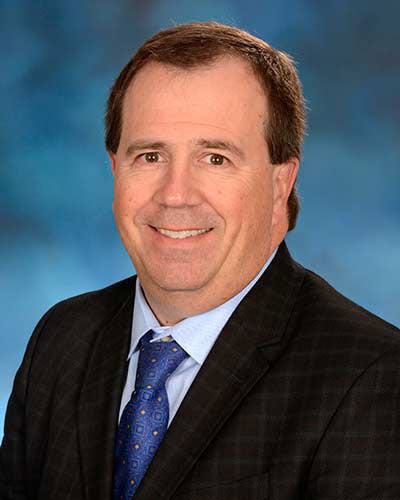
MPower Professor Profile: David J. Weber, Ph.D.
November 29, 2023
In November of 2022, University of Maryland, College Park (UMCP) President Darryll J. Pines and University of Maryland, Baltimore (UMB) President Bruce E. Jarrell named six professors to the second cohort of MPower Professors. This award from the University of Maryland Strategic Partnership: MPowering the State (MPower) recognizes, incentivizes, and fosters collaboration between faculty from each campus who are working together to solve the grand challenges of our time.
Selected for his commitment to interdisciplinary and interprofessional collaboration, David J. Weber is a professor in the Department of Biochemistry and Molecular Biology at the University of Maryland School of Medicine, with a joint appointment as professor of chemistry and biochemistry in the UMCP College of Computer, Mathematical, and Natural Sciences. He is co-director of the Institute for Bioscience and Biotechnology Research (IBBR); director of the Center for Biomolecular Therapeutics (CBT); and director of the Maryland Center for Advanced Molecular Analysis.
Dr. Weber’s research examines the structure, function, and inhibition of potential therapeutic targets in cancer, diabetes, heart disease, and infectious disease. He was co-director of a $7.9 million federal grant to acquire a superconducting 950 MHz nuclear magnetic resonance (NMR) magnet that is helping researchers develop new agents to treat cancer, AIDS, and other diseases. The grant makes the University of Maryland the only academic institution and one of only two sites in the United States to have a 950 MHz NMR spectrometer.
Can you briefly explain the type of research you do?
We use multiple state-of-the-art methods, including nuclear magnetic resonance (NMR), cryogenic electron microscopy (CryoEM), X-ray crystallography, and number protein engineering and target validation/screening methodologies, to conduct basic science research focused on determining structure/function relationships and structure-based drug design.
What drives you to do this research?
Nothing is more exciting to me than learning how biological processes in mammals function at the molecular level. This information is also key to developing highly specific vaccines and therapeutics needed for human health—another major motivational component of my job.
What does it mean to you personally to be named an MPower Professor?
It was truly an honor. I find that bringing the two major campuses together in a complementary research setting in the Center for Biomolecular Therapeutics (CBT) and the Institute for Bioscience and Biotechnology Research (IBBR) is truly rewarding, and getting recognized for this is just a bonus.
How do you collaborate with researchers outside of your discipline, and why is this collaboration important to you?
Collaboration is very common. For the difficult problems in science, biology, chemistry, etc., no one person or group can “do it all”. Joining efforts saves a large amount of time and energy. It really is a waste reinventing the wheel when another group knows how to do something. Of course, such expertise needs to be spread among the group and this is done much more rapidly within a collaboration.
We’ve learned to bring everyone into a room regularly to discuss their research and common goals, and eventually people start paying attention to each other. I find it amusing that at the initial meetings, everyone is working on their cell phones instead of paying attention, but after a few sessions, the phones are no longer a problem.
What other researchers have you worked with on MPower Collaborations?
Because the CBT and IBBR are each built on collaborative efforts, this list is long and not exhaustive. A few I can point to with new funding include:
- France Carrier (University of Maryland, Baltimore School of Medicine): Targeting A18 in melanoma and other cancers
- Alex MacKerell (University of Maryland, Baltimore School of Pharmacy): Computer-aided drug design
- John Marino (National Institute of Standards and Technology): Biomeasurement sciences and biomanufacturing
- Roy Mariuzza (Institute for Bioscience and Biotechnology Research): Structural immunology
- Daniel Nelson (University of Maryland, College Park, College of Agriculture and Natural Resources): Targeting infectious disease
- Vincent Njar (University of Maryland, Baltimore School of Medicine): Developing anti-cancer drugs for pancreatic and/or prostate cancer
- Gerald Wilson (University of Maryland, Baltimore School of Medicine): Target validation and screening
How do the funds awarded from MPower support your research and help facilitate collaborations with other researchers?
The CBT awards $5,000 starter grants to students and postdoctoral students to facilitate collaboration among faculty throughout the College Park and Baltimore campuses and the CBT and IBBR. By freeing up $50,000 of my salary requirements, I can fund 10 students or postdoctoral students to initiate projects for next-step consideration.
What are the next steps for your research?
Our major therapeutic research goals include developing drugs for melanoma (collaboration with Carrier), prostate and pancreatic cancer (collaboration with Njar), and infectious disease including C. diff (collaboration with Nelson). We also have an exciting new opportunity to develop a new anti-metastatic agent while simultaneously incorporating manufacturing procedures (collaboration with John Marino of NIST).
Next steps also include pushing “Team Science” throughout UMB/UMCP via large center grants and other cooperative efforts such as those in the University of Maryland Marlene and Stewart Greenebaum Cancer Center, which is another major effort for “bench to bedside” research. Lastly, the new Institute for Health Computing—an MPower partnership—will enhance our ability to take results from the bedside back to the bench via sophisticated computational approaches that will help determine future efforts to develop next-generation medicines.
To learn more about the Institute for Bioscience and Biotechnology Research, please visit https://www.ibbr.umd.edu/
To learn more about the Center for Biomolecular Therapeutics, visit https://www.medschool.umaryland.edu/cbt/
To learn more about the University of Maryland Strategic Partnership: MPowering the State (MPower) visit https://mpower.maryland.edu/