Skip site navigation
University of Maryland Division of Research
Who We Are Capabilities Partnerships Resources News
Analytical Nuclear Magnetic Resonance (NMR) Service & Research Center Biomolecular Nuclear Magnetic Resonance (NMR) Facility Biosciences Cores: Genomics, Imaging, and Flow Cytometry BioWorkshop Brain & Behavior Institute - Advanced Genomic Technologies Core CALCE Test Services and Failure Analysis Laboratory Center For Innovative Biomedical Resources (CIBR) Clarice Smith Performing Arts Center Daikin Energy Innovation Lab DLAR Imaging Core Exposome Small Molecule Core Facility Glenn L. Martin Wind Tunnel Herschel S. Horowitz Center for Health Literacy KIT-Maryland MEG Lab Maryland Fire and Rescue Institute (MFRI) Maryland NanoCenter Maryland Neuroimaging Center Mass Spectrometry Facility Michelle Smith Collaboratory for Visual Culture Neutral Buoyancy Research Facility (NBRF) Surface Analysis Center The Laboratory for Biological Ultrastructure The University of Maryland Center for Health Equity The University of Maryland Prevention Research Center X-ray Crystallographic Center (XCC)
Africa Through Language and Area Studies (ATLAS) Anti-Black Racism Initiative Effective and Equitable Weather Forecasting in a Changing Climate with Machine Learning Encuentros: A University-Community Partnership to Mitigate the Mental Health Crisis for Latino Immigrant Youth Fostering Inclusivity through Technology (FIT) Helping Our Bodies Clear Respiratory Infections The Maryland Safe Drinking WATER Study Modeling the Evolution of Avian Influenza Viruses Music Education for All Through Personalized AI and Digital Humanities Observing Wildfires Through UAVs and Fire Imaging Technologies Programmable Design of Sustainable, All-Natural Plastic Substitutes Racial and Social Justice Research-Practice Partnership Collaborative Remediation of Methane, Water, and Heat Waste Seizing Opportunities: Social Capital, Businesses, and Communities Using Machine Learning to Measure and Improve Equity in K-12 Mathematics Classrooms Water Emergency Team
Accurate, Equitable, and Transparent Genetic Ancestry Inference Advancing Environmental Justice By Evaluating Climate-Ready Urban Street Trees In Historically Redlined Neighborhoods AFTER: A Hospital Violence Intervention Program For Youth Victims of Gunshot Injury An Innovative Intervention to Help Asian American Families Cope with Racism and Mental Health Difficulties Bridging the Gaps in Satellite Observations of Earth Systems to Support Climate Monitoring and Prediction Climate Change and Political Conflict Climate Mitigation and Land-Use Digital Equity Mapping Research and Training Program Establishing a Role for Psilocybin in Frontal Lobe Function Fetal Mammary Stem Cell Programming and Hormone Dysfunction Forecasting Acute Malnutrition for Anticipatory Action Genetic and Lifestyle Risk Factors of Accelerated Brain Aging in Severe Mental Illness How Does Statistical Learning Interact with Socioeconomic Status to Shape Literacy Development? Human Rights Politics and Policies: Lessons from Latin America Increasing Sustainability, Accessibility, and Equity in Urban Mobility with A Self-driving E-Scooter Increasing Participation of Minorities and Women In STEM Through Sports Performance Analytics Research Market Design, Energy Storage, and Interconnection to the U.S. Power Grid On-board Energy Harvesting for Long-endurance Earth Observation UAVs Promoting Youth Mental Wellbeing in Rural Honduras by Engaging Teachers as Catalysts Relating Attitudes on Democracy to Attitudes on Race and Ethnicity An Innovative Approach to Remove Emerging Organic Contaminants from the Environment Role of Mitochondria Dynamics in Opioid Addiction Towards an Early Warning System for Increased Probability of Community Infection by SARS-Cov-2 Variants Understanding the Impact of Wind on Fire Dynamics in Mass-Timber Compartment Visualizing Urban Flooding Due To Climate Change
Search
Who We Are Capabilities Partnerships Resources News

Inventions of the Year: UMD, JHU Researchers Develop AI-Enhanced Digital Otoscope for Diagnosing Pediatric Ear Disease

Invention could reduce trips to doctor, improve diagnostic accuracy of ear infections.

May 18, 2022

Inventor John Rzasa

Ear infections, or the inflammation of the middle ear typically caused by bacteria, are a notorious nuisance in early childhood. The high incidence, recurrent nature, and non-specific presentation of ear infections in children have made it a feared diagnosis among parents. According to the National Institute on Deafness and Other Communication Disorders, ear infections are the most common reason for a trip to the pediatrician, with five out of six children experiencing at least one ear infection by age three, and 25% of children having repeated ear infections. Researchers at the University of Maryland (UMD), in collaboration with Johns Hopkins University (JHU), have developed an innovative technology that could save a trip to the doctor’s office by enabling virtually anyone to record and triage a child’s symptoms and status confidently and competently.

John Rzasa, chief engineer of UMD’s Robert E. Fischell Institute for Biomedical Devices, along with James H. Clark, assistant professor of otolaryngology at JHU and Mathias Unberath, assistant professor of computer science at JHU, teamed up to create a multi-pronged system to improve the diagnosis of pediatric ear infections. 
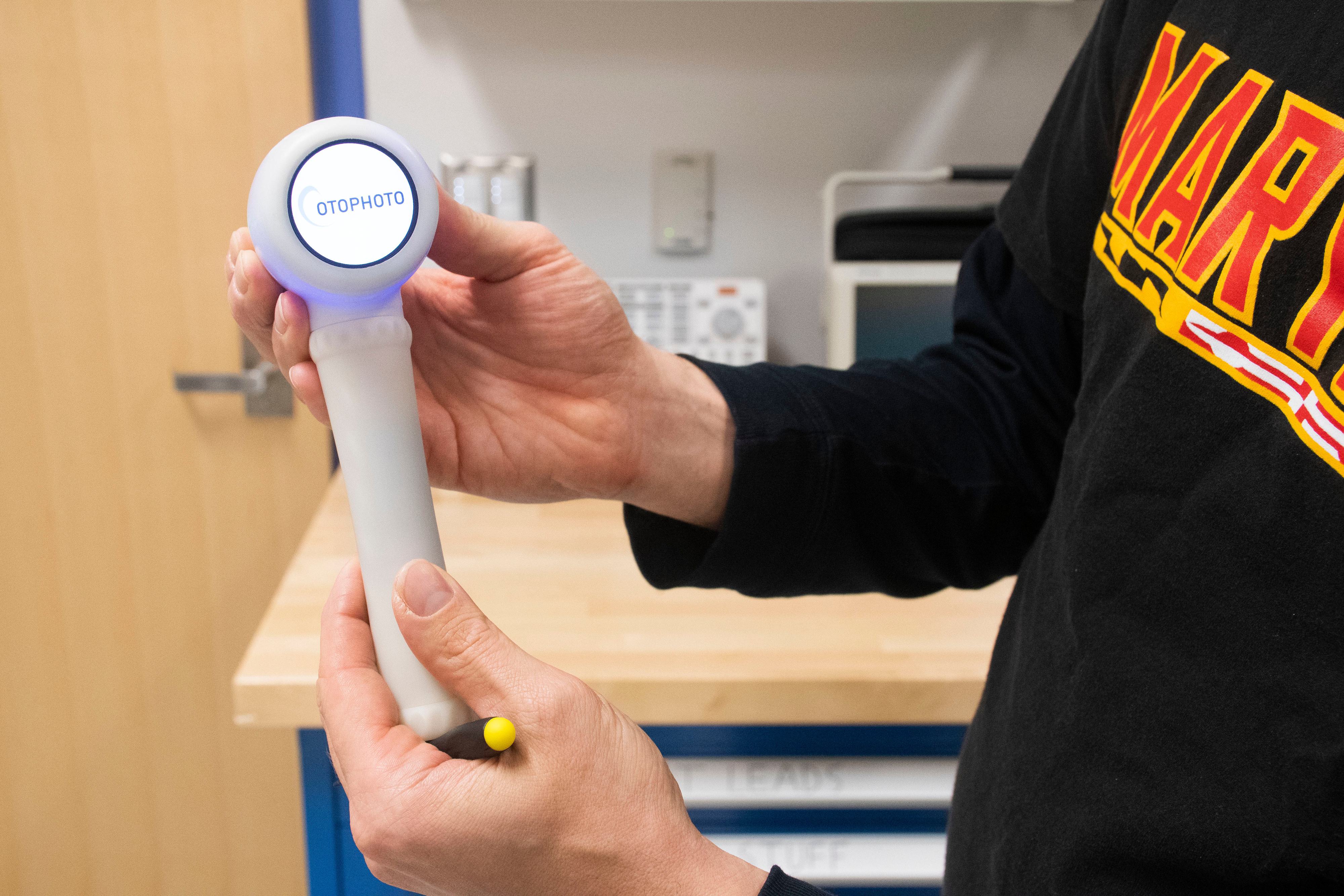
The Otophoto
The OtoPhoto Photo by Sage Levy

The technology consists of three distinct components: a novel video-based artificial intelligence (AI) algorithm that diagnoses ear disease from video; a unique, specialized digital otoscope capable of capturing a high-quality ear exam even with a novice user; and an application for a smart device, which can record the data from the digital otoscope, use the AI algorithm, and communicate with an electronic medical record. With this device, called “OtoPhoto,” physicians, medical assistants, and even parents at home can safely and confidently probe a child’s ears and get results quickly to confirm or rule out an ear infection.

While several direct-to-consumer digital otoscopes are commercially available, the OtoPhoto system surpasses its predecessors with improved video quality, compensation for user error, and sophisticated AI capabilities. OtoPhoto can also be used wirelessly, eliminating the need to be tethered by a cable to a screen, which makes current digital otoscopes ergonomically challenging to use and cumbersome to set up. This invention has the capability to reduce visits to the pediatrician, improve the diagnostic accuracy of ear infections, and subsequently reduce the need for antibiotics. 

The team’s research was funded in part by a grant from the Leon Lowenstein Foundation in conjunction with JHU. Research on the video-based AI algorithm component of the invention has been published in Frontiers in Digital Health.  

Rzasa, Clark, and Unberath’s invention was recognized as a finalist in the physical sciences category for the Invention of the Year awards, which were celebrated on May 3 at the 2022 Innovate Maryland event, a university-wide celebration of innovation and partnerships at UMD.