
Inventions of the Year: The “Coronalyzer”—Sensor Developed by UMD Researchers Detects SARS-CoV-2, the virus responsible for COVID-19, in Human Breath
May 18, 2022

The COVID-19 pandemic has illustrated how quickly a new pathogen can fundamentally change economies and society. Early in the pandemic, public health professionals demanded quick and accurate testing to track and control the spread of COVID-19 but still struggle to do so using existing testing methods. Two years after its first recorded case, however, researchers at the University of Maryland (UMD) are developing faster, less invasive, and more reliable means of diagnosing pathogens like COVID-19.
At present, the reverse transcription-polymerase chain reaction (RT-PCR) test is the gold standard for quickly and accurately identifying positive cases of COVID-19. However, these tests still take a minimum of three hours to provide a result and can only detect infections 48 hours after exposure. Rapid antigen testing aimed to speed up screening for the virus with detection in as little as 15 minutes. They did so at the expense of precision, as these tests are limited to symptomatic subjects due to poor limit of detection and high instances of false negatives. Thus, the need for fast and accurate testing remained.
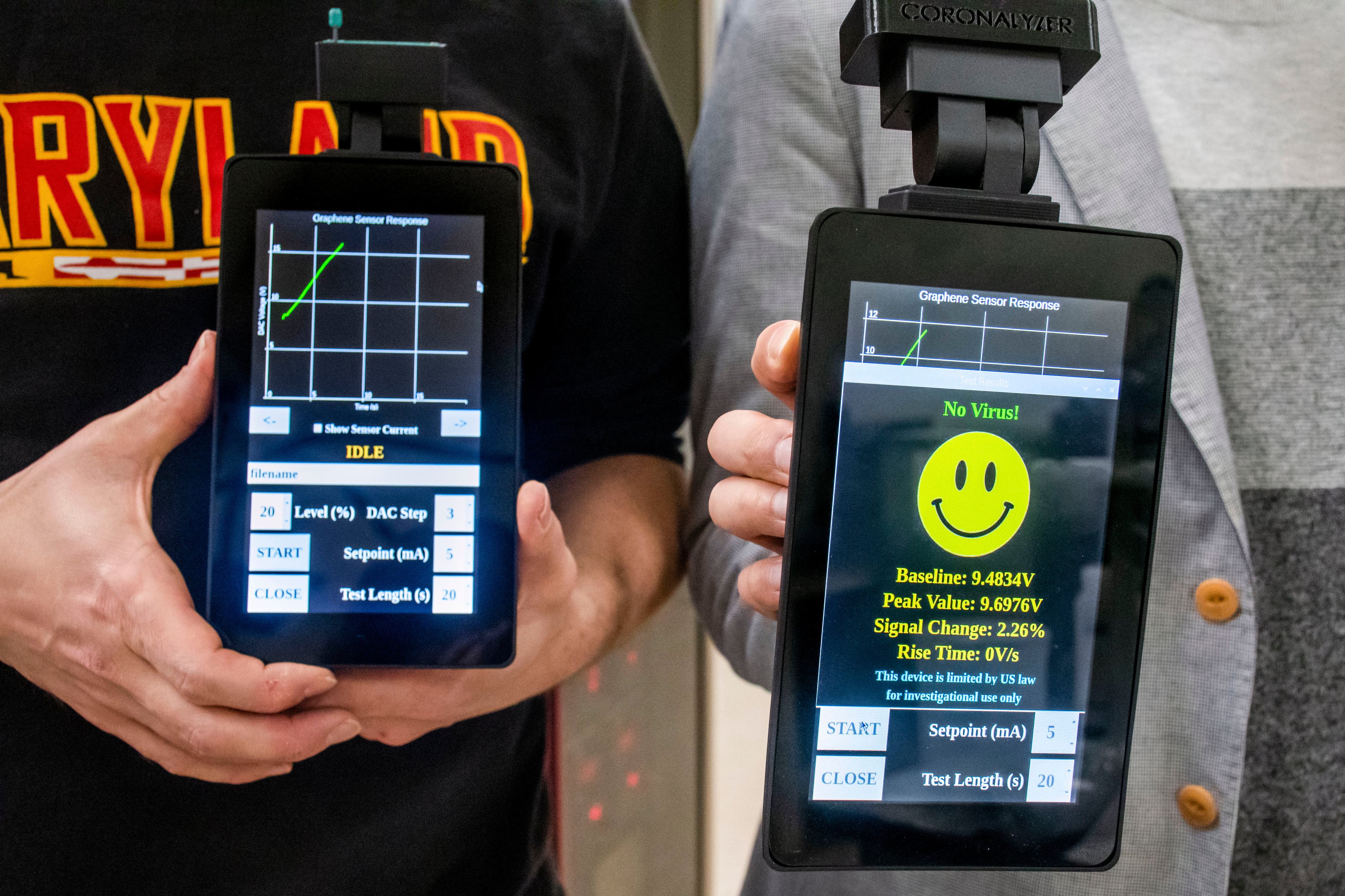
To meet this need, three researchers at UMD’s A. James Clark School of Engineering—Kevin Daniels, assistant professor in the Department of Electrical and Computer Engineering with a joint appointment at the Institute for Research in Electronics and Applied Physics (IREAP); Soaram Kim, postdoctoral research associate at IREAP; and John Rzasa, chief engineer in the Robert E. Fischell Institute for Biomedical Devices—have invented what they have dubbed “the Coronalyzer,” a system capable of detecting COVID-19 in less than a second.
Much like a traditional breathalyzer detects the presence of alcohol, the Coronalyzer uses a graphene-based sensor functionalized with SARS-CoV-2 S1 spike protein antibodies—the proteins created by the immune system during infection with COVID-19—to detect the presence of the virus in the breath. When the SARS CoV-2 S1 spike protein antigens, the proteins that surround the virus, come into contact with the sensor and bind with the functionalized antibodies, a small strain is induced in the graphene layer resulting in a large change in its electrical resistance, which can be detected electrically in under one second. From this novel sensing mechanism, the system can detect minuscule amounts of antigen, with an order of magnitude better sensitivity than that of RT-PCR tests and at a rate much faster than rapid antigen tests, promising to increase society’s ability to track and proactively manage the COVID-19 pandemic.
This invention's usefulness extends beyond COVID-19, as the sensor can be quickly implemented to screen novel pathogens and adapt to changing mutations in viruses like COVID-19, influenza, and HIV, by simply changing the immobilized selective biomarkers on the sensor. In addition, this work is applicable to biological detection outside of pathogens, including cancer and DNA/RNA, with the immobilization of respective biomarkers. The system fills a gap in medical diagnostics by eliminating the trade-off between speed and sensitivity observed with RT-PCR and rapid antigen tests. The sensor is presented in an intuitive and user-friendly package, removing the need for expensive equipment and trained professionals to operate.
The work was funded by a seed grant from the Medical Device Development Fund (MDDF), which is part of UM Ventures, which like the Fischell Institute, is a key initiative that links the College Park and Baltimore campuses on health-related device technologies. The work was also supported by collaborators Heeju Ryu at the Fred Hutchinson Cancer Research Institute, Rachael Myers-Ward at the U.S. Naval Research Laboratory, and Don Milton, Sheldon Tai, and Michael Pedowitz at the University of Maryland.
Daniels, Kim, and Rzasa hope that the Coronalyzer will allow for rapid disease detection in high-traffic areas and places where social distancing is not possible. The sensor will be especially useful in healthcare settings to provide quick and quantitative health screening and monitoring. They plan to launch a startup company for their work and have already gained powerful market research for the device through the National Science Foundation’s regional I-Corps program.
The researchers’ invention, “The Coronalyzer: Sensor System for Detecting COVID From Human Breath,” was recognized as a finalist for a UMD Invention of the Year award in the Physical Sciences category. The event was held on May 3, 2022, at Innovate Maryland, a campus-wide celebration of innovation and partnerships at UMD.